
A Note to the Reader
Before we begin, we want to clarify what this article is—and is not.
Our purpose here is not to criticize the Hugh Lynn Cayce manuscript (HLC) or tell students which edition of A Course in Miracles they should prefer. The HLC is an important version of the Course, and we have many reasons for valuing it.
The purpose of our podcast episode, “Did Bill Thetford Edit A Course in Miracles?”, and this companion article is to examine one historical claim: Was Bill Thetford the primary editor of the HLC?
This question matters because the HLC is sometimes called the “Thetford Edit,” a name that carries with it a specific claim that Bill was its primary editor and that the HLC therefore uniquely reflects his editorial judgment. After examining both the eyewitness testimony and the manuscripts themselves, we do not see any historical evidence that supports that story.
In the podcast, we walk through this evidence and discuss what we think it tells us about Bill’s and Helen’s respective roles. You can watch that episode below.
In this article, we have laid out the case point by point and also included a summary of our evidence so that students can examine it for themselves.
For clarity, in this discussion we are mainly concerned about changing and removing words. Given the Course’s claim that its words come from Jesus, students want to know to what degree someone removed or changed his words. This means we are not particularly concerned with other changes to the original dictation:
- Chapter and section breaks
- Chapter and section titles
- Capitalization, paragraphing, and punctuation
- Proofing to find typographical errors
These aren’t the kinds of editing that determine whether you have the pure version that Jesus dictated.
One final clarification: When we discuss the editing of the Course, we are primarily talking about the first four to nine chapters of the Text, where the majority of the editing occurred. We also want to emphasize that nothing in this discussion changes our affirmation of all editions of A Course in Miracles. While there are meaningful differences among them, students will find the same overarching message in each.
Our Case in Brief
Behind the claim that Bill Thetford edited the Hugh Lynn Cayce manuscript (HLC) is the fact that Jesus did assign Bill a key editorial role early in the dictation. He said, “Ask him [Bill] later if this should be included in the written part of the course at all, or whether you should keep these notes separately. He is in charge of these decisions.” This gave Bill the important editorial function of deciding what belonged in the Course and what was too personal to Helen and Bill to include.
The question, however, is: Did Bill actually fulfill this role? What does the evidence say?
Here is what we found:
First, no eyewitness or close associate of Bill’s identifies him as the HLC’s primary editor. Not Bill himself. Not Helen. Not Ken Wapnick. Not Judy Skutch Whitson. Not Carol Howe. Despite several people mentioning editing in the form of removing words, changing words, dividing and titling chapters and sections, punctuation, paragraphing, capitalization, and proofing, no one portrayed Bill as taking the lead on any of it.
Second, there are eyewitnesses who deny that Bill was the editor. Ken Wapnick specifically denied that Bill played this role. He said Helen was always the lead editor on all their writing projects, since Bill did not have the patience for editing while Helen was a passionate editor. Speaking of editing she witnessed, Judy said that Bill “made suggestions gently” while “Helen was totally in charge.”
Third, eyewitnesses say that Helen, rather than Bill, was the editor. Ken was repeatedly clear that “Helen was the editor.” Judy said that, when it came to editing processes she saw, “Helen would ‘rule the roost.’”
Fourth, the textual evidence says that Helen was the editor. Across the versions, one editorial hand appears to be working throughout, with a bias toward removing material, removing references to specific things in the world, and making the language vaguer and more general. This hand must have been Helen’s, since she was the only one involved in all the editing processes: she edited the Notes, she edited while dictating the Urtext, she typed and edited the second draft, she typed and edited the HLC with Bill’s involvement, and later she worked with Ken on the FIP edition. Further, the editing we see fits known tendencies of hers: she was a compulsive editor; she went into “an almost fierce over-editing” when she was anxious about material—which she was about the Course’s early chapters; and she was extremely invested in the Course’s final form and insistent about it going her way.
Fifth, the HLC is not the minimally edited version this claim assumes. The HLC is already extensively edited, both in removing words and changing words. Approximately 33,000 of the roughly 45,000 words removed between the Notes and the FIP edition were already gone in the HLC. The HLC also contains extensive line-by-line editing. The HLC, in fact, is the most heavily edited version, apart from the FIP version that came after.
Sixth, the HLC looks like a continuation of the editing Helen had already been doing. The manuscripts themselves show a continuous pattern of editing: concrete material is progressively removed, and the language becomes increasingly general and abstract. In this light, the HLC appears to be a continuation of what Helen had already been doing, rather than a separate editorial philosophy inserted into the process by Bill.
Seventh, Bill himself did not treat the HLC as final. After its completion, Bill asked for further editing, participated in the process that produced the FIP edition, and subsequently treated the FIP as the completed Course. Every indication says that he regarded the HLC as a draft and the FIP edition as the Course.
Conclusion: Looking at the evidence, you can see that it speaks with one voice:
- No eyewitness or close associate of Bill’s identifies him as the HLC’s primary editor.
- There are eyewitnesses who deny that Bill was the editor.
- Eyewitnesses say that Helen, rather than Bill, was the editor.
- The textual evidence says that Helen was the editor.
- The HLC is not the minimally edited version this claim assumes.
- The HLC looks like a continuation of the editing Helen had already been doing.
- Bill himself did not treat the HLC as final.
Therefore, while Jesus assigned Bill a core editorial function, and while Bill did contribute to the editing, the evidence is clear that he did not carry out that assigned role. Instead, Helen was the primary editor throughout.
Here is the case, point by point, in more detail.
The Eyewitness Testimony
Jesus did give Bill an important editorial responsibility.
The idea of Bill as editor has a real historical basis. Early in the dictation, Jesus told Helen:
Ask him [Bill] later if this should be included in the written part of the course at all, or whether you should keep these notes separately. He is in charge of these decisions.
This gave Bill the key editorial function of deciding what belonged in the Course and what was too personal to Helen and Bill to include. But this instruction establishes what Bill was asked to do. It does not by itself establish what role he actually played in producing the HLC. That requires evidence.
And this is where the problem with the “Thetford Edit” claim begins.
No eyewitness identifies Bill as the HLC’s lead editor (including Bill himself).
If Bill had been the primary editor of the HLC, we would expect this fact to appear somewhere in the accounts of the people who were involved. Looking to those who were present at the time, it is striking that literally no one mentions Bill in this role:
- Bill never describes himself as the lead editor.
- Helen never describes Bill as the lead editor.
- Ken Wapnick never describes Bill as the lead editor.
- Judy Skutch Whitson never describes Bill as the lead editor.
- Even Carol Howe who, though not an eyewitness, was close to Bill and wrote a biography devoted to his contribution to the Course, does not portray him this way.
While these sources do discuss many aspects of the editing process—removing material, changing words, dividing the text into chapters and sections, adding titles, changing capitalization and punctuation, paragraphing, and proofreading—again, no one portrayed Bill as taking the lead on any of these.
Bill’s own testimony here is especially significant. When asked directly for New Realities magazine whether he and Helen edited the Course, he flatly said, “No,” saying that all they had done was to delete personal material and make changes involving capitalization, punctuation, paragraphing, section divisions, and section titles.
Whatever we make of the accuracy of that recollection, it is difficult to reconcile it with the idea that Bill regarded himself as the primary editor of a distinct “Thetford Edit.”
Eyewitnesses deny that Bill was the editor.
Ken Wapnick repeatedly denied that Bill played this role. Referring to the guidance from Jesus that Bill was in charge of what should stay in vs. come out, Ken said,
That certainly did not mean that Bill was the one to do all the editing. This was not his strength. Helen was the editor on their team. Bill did not have the patience for it. (“Editing History”)
He said Helen was always the lead editor on all their writing projects, since Bill did not have the patience for editing while Helen was a passionate editor. Judy vividly described work on editing she personally witnessed, saying that Bill “made suggestions gently” while “Helen was totally in charge.”
The eyewitnesses who do identify a lead editor say it was Helen.
Ken Wapnick was repeatedly clear that “Helen was the editor.” In a 2004 letter to Robert Perry, Ken wrote:
The issue of Bill being the editor has been widely misunderstood…. Helen was always the primary editor.
Ken described their respective roles this way:
You can perhaps think of Bill as her consultant, and me as her secretary, who carried out her wishes.
Judy Skutch Whitson, who personally witnessed some of the editing, gave a similar picture:
Helen was totally in charge. Bill made suggestions gently, Ken sat by quietly and unobtrusively, and Helen would “rule the roost.” (Never Forget to Laugh, p. 109)
These statements indicate that Bill contributed suggestions and exercised influence. But, again, contributing to the editing is different from being the primary editor. And the eyewitness testimony consistently points to Helen.
The Textual Evidence
Eyewitness testimony is only one form of evidence. We can also compare the different versions of the Course itself and see what happened to the Text as it moved through successive editing processes. When we do that, it’s clear the same editorial tendencies are present across each subsequent version.
For example:
1. With each pass, more and more material is removed.

2. With each pass, there is more removal of references to specific things in the world.
The following is a partial list of specific topics that were removed from the Course.

A markedly pronounced example of this tendency is in how consistently teachings on sex are removed.

Note also that references to the word “sex” go from 50 in the Notes to 1 in the HLC and 0 in the FIP.
3. The language is made more abstract, vague, and general.

Notice that the specific and lively language in the Notes becomes more vague and general in the FIP edition. For example, “It pulls the will into its own service, and forces the mind to concur” becomes “It brings the mind into its service.” Likewise, “inappropriately exposed to a straight and undiluted miracle” becomes “prematurely exposed to a miracle.”
Whose editorial hand was responsible for these tendencies?
From the textual evidence, then, there does not appear to be one identifiable editing philosophy producing the HLC and then a different one producing the FIP. Once again, these same editorial tendencies continue from one version to another. What we appear to see is one hand operating throughout.
The question is: Whose hand was it?
Helen is literally the only candidate, as she is the one person involved in every stage of the editorial process:
- Helen edited the Notes.
- Helen edited while dictating the material to Bill in the Urtext.
- Helen typed the second draft of the Text by herself and, according to Ken, “edited as she went along.”
- Helen typed the HLC, editing as she went along with Bill, according to Ken, “as her consultant.”
- Helen worked with Ken on the FIP edition.
Furthermore, the editorial tendencies described above also fit what we know about Helen’s editing style.
Helen was known to be a compulsive editor.
Helen is repeatedly described as a compulsive editor. Ken said that with the professional articles she and Bill wrote, after he wrote the draft, “Helen then would tear it apart, edit, and re-edit it” (“Editing History”).
The following is a page from Helen’s unpublished autobiography where you can see the editorial impulses Ken describes:

Helen went into “an almost fierce over-editing” when she was anxious about material.
Importantly, Ken also described Helen as engaging in “an almost fierce over-editing” when she felt anxious about or embarrassed by material. And the material she felt particularly anxious about was the early chapters of the Course—the very material that underwent the most editing.
As the text moves on, the writing becomes more and more beautiful…. This is not the case in the first four chapters, however. And Helen was always very ashamed of them. (The Urtext and the Early Chapters of the Text of ACIM,” by Ken Wapnick)
Helen was extremely invested in the Course’s final form and insistent about it going her way.
Ken also repeatedly described Helen as very protective of the Course’s final form and unwilling to allow changes she did not approve.
As I have said many, many times, Helen was extraordinarily protective of A Course in Miracles, and would not have allowed anything to be done with the material without her approval. (“The Early Manuscript of ACIM Given To Hugh Lynn Cayce,” by Ken Wapnick)
No one, including Jesus, could ever get her to do anything she did not want to do. (Ken Wapnick, “Editing History”)
Taken together, the simplest explanation of the textual evidence is that Helen was the primary editorial hand throughout the process.
- Helen was the only one involved in all the editing processes.
- Helen was known to be a compulsive editor.
- Helen went into “an almost fierce over-editing” when she was anxious about material—which she was about the Course’s early chapters.
- Helen was extremely invested in the Course’s final form and insistent about it going her way.
The HLC is not minimally edited
For those who advance the idea of a “Thetford Edition” of A Course in Miracles, part of the appeal is that it assumes the HLC is far less edited, far more “pure.” But this claim does not stand up when you compare the HLC to the Notes before it and to the FIP after it.

Approximately 33,000 of the 45,000 words removed in the first 9 chapters of the Text happened between the Notes and the Hugh Lynn Cayce edition.
Although it’s true that Bill had a commendable value on preserving the Course as close to the Notes as possible, the data shows that approximately 33,000 of the 45,000 words removed in the first 9 chapters of the Text happened in between the Notes and the Hugh Lynn Cayce edition.
Moreover, the word changes within sentences appear to be just as frequent in the HLC as in the FIP, if not more so. For instance, in what became miracle principle 5, by the time we get to the HLC, 29 words have been changed, added, or removed. Yet there are no wording changes between the HLC and the FIP. You can see detailed comparisons of this miracle principle as well as a longer passage at the end of this piece in the section “Examination of examples of editing.”
While the FIP version of the Course is the one often accused of being over-edited, what you see by comparing word counts and wording changes across the editions is that the FIP is basically the same editing tendencies that produced the HLC, just carried one step further. By far, the bulk of the editing occurred before the FIP edition—and indeed before Helen and Bill had even met Ken Wapnick. (The Hugh Lynn Cayce manuscript is commonly dated 1972; Ken met Helen and Bill later that same year after the HLC was completed.)
Bill wanted editing beyond the Hugh Lynn Cayce manuscript
It’s also important to note that, when the HLC was complete, Bill was the one urging Helen for further editing.
He [Bill] recognized the need for more [editing] and had been urging Helen, although with ambivalence, for several months to join him in renewing the process. (Never Forget to Laugh, p. 108)
Neither of them [Helen and Bill] felt completely satisfied with the work they had done [on sectioning and titling]. (Journey Without Distance, p. 89)
If Bill viewed the HLC as complete, *why would he be urging more editing? *
Additionally, when Helen and Ken picked up the editing process to produce the FIP, we know that Bill approved and was involved. For example, Ken reports that Bill insisted on 50 miracle principles (as opposed to the HLC’s 53) and that Bill okayed any reordering of material. Judy reports Bill being involved with discussions about capitalization and, when the FIP edition was finished, Ken said “we all worked hard” to make sure this was the edition that Jesus wanted.
Bill viewed the Foundation for Inner Peace edition as the completed Course
By all accounts, Bill happily used the FIP edition when it was published. He gave no indication that he considered the FIP anything other than the completed version of A Course in Miracles. When Bill refers to “the Course,” he always means the FIP edition. And we have no record of him speaking to anyone about the HLC as his unique editing contribution or saying that he preferred it in any way. On the contrary, all the evidence we have points to Bill viewing the HLC as a draft and the FIP as the final.
Conclusion
Was the Hugh Lynn Cayce manuscript the “Thetford Edit”?
The historical evidence does not support that description.
There is no question that Jesus gave Bill an important editorial responsibility. There is no question that Bill participated in the editing of the Course, made suggestions, exercised influence, and helped determine what belonged in the final work.
But none of that establishes the specific claim that Bill was the primary editor of the HLC.
For that claim to stand, we would expect to find evidence of Bill actually occupying that role.
Instead, we find the following:
- No eyewitness identifies Bill as the HLC’s primary editor (including Bill himself).
- Eyewitnesses deny that Bill was the editor.
- The eyewitnesses who do identify a lead editor say it was Helen.
- The textual evidence says that Helen was the editor throughout.
- The HLC is not the minimally edited version this claim assumes.
- The HLC looks like a continuation of the editing Helen had already been doing, rather than a product of a distinct “Thetford” editorial phase.
- Bill himself did not treat the HLC as final, but treated the FIP edition as the completed Course.
Therefore, the simplest explanation of all this evidence is that Helen was the primary editorial hand throughout the Course’s development, with Bill serving as an important collaborator and consultant.
This does not make the HLC less valuable. Nor does it settle every question about the editing history of A Course in Miracles, including editorial changes apparently introduced by Ken Wapnick, some of which we believe were problematic in their own right. What all of this means is only that calling the HLC the “Thetford Edit” tells a story the evidence simply does not support.
And that should matter to us.
When we attach a person’s name to a manuscript, we aren’t merely giving it a label. We are making a historical claim about who created it and whose editorial judgment it represents. Particularly with a work as important as A Course in Miracles, those claims should be based on facts.
Moreover, we should be willing to let the facts correct the story when we have gotten it wrong.
None of this diminishes Bill Thetford or his invaluable role in the Course’s history. Bill’s “better way” speech, his years of support during the scribing, and the holy relationship he and Helen shared were all essential parts of the remarkable story of how A Course in Miracles came into being.
At the same time, we don’t need to credit Bill with something the evidence says he didn’t do in order to appreciate the extraordinary things he did do.
On the latter, there is truly so much to celebrate. Bill deserves to be honored. But we honor him best not by assigning him a role the evidence knows nothing about, but by recognizing the extraordinary role he actually played—a role without which A Course in Miracles would never have come into the world.
Our Sources
Witness testimony about who edited the Course

“Editing History: The History of the Manuscripts of A Course in Miracles” by Ken Wapnick:
“Early in the process of the retyping, Jesus told Helen: ‘Leave decisions about editing to Bill.’ At that point, Bill was reasonably sane about the Course and Helen was not—she would have taken out anything that did not ‘read right’ to her. This instruction had to do with the original version that Helen was so anxious about, and therefore her judgment would not be clear—Bill’s would be—about taking out the early material that did not belong. That certainly did not mean that Bill was the one to do all the editing. This was not his strength. Helen was the editor on their team. Bill did not have the patience for it. In fact, when Helen and Bill would write articles—they published many professional articles—Bill would write the rough draft. Helen then would tear it apart, edit, and re-edit it—still another source of tension in their already fractious relationship.”
2004 letter from Ken Wapnick to Robert:
“The issue of Bill being the editor has been widely misunderstood. Bill never had the patience to be an editor. Indeed, when he and Helen would co-author professional articles, Helen was always the primary editor. The ‘instruction’—remember, the specific instruction came through Helen—had to do only with the issue—*at that time—*of Helen not being able to make the decision of what did or did not belong in the published Course, and that Bill would be more objective of that. But this instruction did not include Bill’s actual editing or subsequent role. Indeed, with her two re-typings, Helen edited as she went along. And you are correct that Helen was the editor. You can perhaps think of Bill as her consultant, and me as her secretary, who carried out her wishes.”
Robert: Ken says “you are correct that Helen was the editor” because I had concluded this on my own by studying the editing changes across the versions.
Absence from Felicity, by Ken Wapnick.
“As noted earlier, Helen herself retyped the manuscript twice, and gradually she and Bill broke the material of the text into sections and chapters, supplying names as they went along” (p. 329). “I read a copy of Helen’s second retyping (at least of the text) which was presented to Hugh Lynn Cayce” (p. 359). “Helen and Bill agreed that it did need a final run-through. As Bill lacked the patience for such a task, we decided that Helen and I should go through it together” (p. 360). “Any changes we made in the order of material….we showed Bill, who likewise shared Helen’s attitude of absolute integrity and fidelity to the original dictation” (p. 363). All quotes are from the first edition of Absence from Felicity.
“The Early Manuscript of ‘A Course In Miracles’ Given To Hugh Lynn Cayce,” by Ken Wapnick:
“As I have said many, many times, Helen was extraordinarily protective of A Course in Miracles, and would not have allowed anything to be done with the material without her approval. Indeed, during our long period of editing, I functioned more or less as Helen’s secretary, implementing the changes that she wished.”
Note on whether Ken Wapnick can be trusted as a source.
Ken is unquestionably our most important witness to the editing. He was intimately involved and was the only one who wrote about the editing repeatedly and at length. And his story is consistent. When he reports the facts of what happened, he appears reliable. When his testimony can be checked, it checks out. This differs sharply from Helen’s and Bill’s comments about the editing. They both claim that no words were changed, which runs directly counter to what we see in the different versions. With Ken, it is entirely different. He speaks realistically about what happened. Therefore, we trust the facts that he reports. That being said, when he adds his own interpretive overlay onto those facts, we often disagree with him. Overall, though, he remains our most important and most reliable witness to the editing. His testimony can’t be discounted just because it does not agree with one’s position.
Judy Skutch Whitson on editing she witnessed:
“Helen was totally in charge. Bill made suggestions gently, Ken sat by quietly and unobtrusively, and Helen would ‘rule the roost.’ For those who promote the idea that Ken made all the final decisions and had final editorial approval, quite the opposite was the case. I remember during the proofreading of the ‘blues,’ when challenges to inappropriate capitalizations were made, Ken would just shrug and Helen would always get her way” (quoted in Never Forget to Laugh, p. 109).
Bill’s Life Story:
This does not mention his editorial role or contributions. There is what initially may look like a reference to Bill’s editing role, which says, “As a matter of fact, early on she said to me, ‘You’re responsible for what it says.’ She then told me that she was responsible only for its grammatical style and purity” (p. 22). However, the lines leading into this statement make it clear that it is not about the editing. Here they are:
Helen would read the material to me from her shorthand notebook, and I would type it directly…. We would just pay attention to what we were doing and not get too involved with the content while we were doing it…. Helen was apt to be uneasy if we discussed it [the content]. She felt we should just get it down and be sure it was accurate, and not try to understand what it meant. Helen was fearful, I think, of making any kind of specific commitment about this [about trying to understand what it meant]. As a matter of fact, early on she said to me, “You’re responsible for what it says.”
This context makes it very clear what “You’re responsible for what it says” means: “You’re responsible for trying to understand what it says. I’m responsible for paying attention to its grammatical style and correctness.” This, by the way, was also Ken’s understanding of Helen’s statement to Bill: “In fact she used to say to Bill: ‘You pay attention to what it says. I’ll pay attention to how it says it’” (“Editing History”).
Helen’s published autobiography:
Doesn’t mention the editing. It says only this: “The ‘text’ as it is given is unchanged except for the omission of some of the more personal material which was included only at the beginning. Chapter headings and subdivisions have been added later, but the arrangement of the material, which seemed to fall naturally into these divisions, has not been altered” (p. 44). Helen, unfortunately, cannot provide evidence as to who led the editing because she clearly states that there was no editing, aside from omitting some early personal material and adding chapter headings and subdivisions.
Helen’s unpublished autobiography:
“At the beginning particularly I was tempted to change a word here and there, but the urge to change it back to the original was so strong that I did so fairly soon. In fact, the matter was apt to disturb me until I did. Further, it quickly became apparent that the words were not chosen at random. Sometimes what seemed to be inconsistent at the time was to be explained later, and the original wording was necessary for the sake of subsequent clarity.” Later, Helen says, “Bill was adamant in opposing any changes at all, except for deleting the too personal early references and correcting actual typing errors. I wanted to change just about everything, but I knew that Bill was right. Any changes I made were always wrong in the long run, and had to be put back.” Unfortunately, this supposed practice of changing everything back to its original wording is not at all what happened. In the first four chapters, there were wording changes—typically several per sentence—in 80% of the sentences. Rather than being undone, these changes simply compounded with each new editing pass. What Helen was possibly referring to is that she often crossed out a word in her notebooks and replaced it with a new one, but then read the original word into the Urtext. This was indeed common, but the story doesn’t stop there. After that, she went on to edit the material.
Helen’s interview with Dave Hammond:
Helen is asked, “You tried to edit it at times, didn’t you?” She responds, “Yes, I did. It would bother me and I would never forget what it was originally, and I would feel kind of uneasy about it. But since I do so much editing, I figured, well, I’m improving this, you know, and that’s it. But then later, when it would pick it up again and refer back to that, then it would be inconsistent, because it would use the original word. So then I very quickly learned, ‘Don’t do that, because you will interfere with the internal consistency.’ So then I stopped doing that. Very quickly I learned that that was a very bad mistake. So we went back and we changed all the words back into its original form.” Unfortunately, as mentioned above, this is so far divorced from what we see across the various versions that we cannot take this as meaningful evidence about the editing. Note, however, that Helen here attributes the impetus for this practice of putting all of the original words back to herself, not to Bill. She learned it was “a very bad mistake” to change any words and then, on that basis, “we [she and Bill] changed all the words back.”
New Realities magazine interview with Bill:
NR: There has been some speculation that you and Helen edited the Course. Did you?
THETFORD: No. Bear in mind that at the beginning we didn’t know exactly what was happening. So we asked questions of a personal nature and recorded the answers that Helen would receive. I would type these answers as part of the continuous process, not distinguishing them from the inner dictation that Helen was recording in her shorthand notebook. Later, when we realized that this material was obviously not a part of the Course itself, we did, indeed, delete it. It is true there has been editing of capitalization, punctuation, paragraphing and section titles in the Text. However, these changes were minor and the Workbook and the Manual for Teachers also appear exactly as they were taken down by Helen.
Bill flatly denies that any editing took place, apart from removing personal material that came in response to their questions and that “was obviously not a part of the Course,” and apart from “capitalization, punctuation, paragraphing and section titles in the Text.” Bill’s testimony, therefore, cannot be used to decide who was the editor because, in his view, there was no editing, at least no meaningful editing. It is noteworthy that he doesn’t mention his supposed role as lead editor of the HLC. If he fulfilled that role, why say that no one filled it?
Never Forget to Laugh: biography of Bill by Carol Howe:
Carol’s book refers to Helen and Bill collaborating on section breaks, paragraphing, capitalization, etc. It specifically mentions Bill recognizing the need for more editing after the HLC. It quotes Bill’s friend Jaison Kayn: “‘Bill would defer to Helen because she did the actual scribing,’ he observed, as have many others close to Bill” (p. 89). Referring to the HLC: “Helen and Bill had already gone through the text more than once and, though they had removed much personal material, as well as references to Freud, Jung, Cayce, and several friends and colleagues, the capitalization was inconsistent, some section headings were not clear, and some personal information remained. Bill was burned out by the initial editing process, but he recognized the need for more and had been urging Helen, although with ambivalence, for several months to join him in renewing the process; she refused. Now, however, with growing admiration for Ken, tireless, enthusiastic, and ready to serve her completely, she was persuaded to start another round of editing” (p. 108). Carol’s book also contains the important statement from Judy Skutch Whitson, quoted in full above, that “Helen was totally in charge” of the editing process.
Journey Without Distance, by Robert Skutch:
Refers to both Helen and Bill structuring the HLC: “Helen and Bill read slowly through the Text, feeling and asking where the natural breaks might occur” (p. 78). [Worth noting here that Helen’s Notes include many section and chapter breaks already.] Mentions Bill recognizing the need for the FIP: “For though Helen and Bill had done the initial work of breaking the manuscript into sections, neither of them felt completely satisfied with the job they had done” (p. 89).
Correspondence from Helen and Bill with Hugh Lynn Cayce:
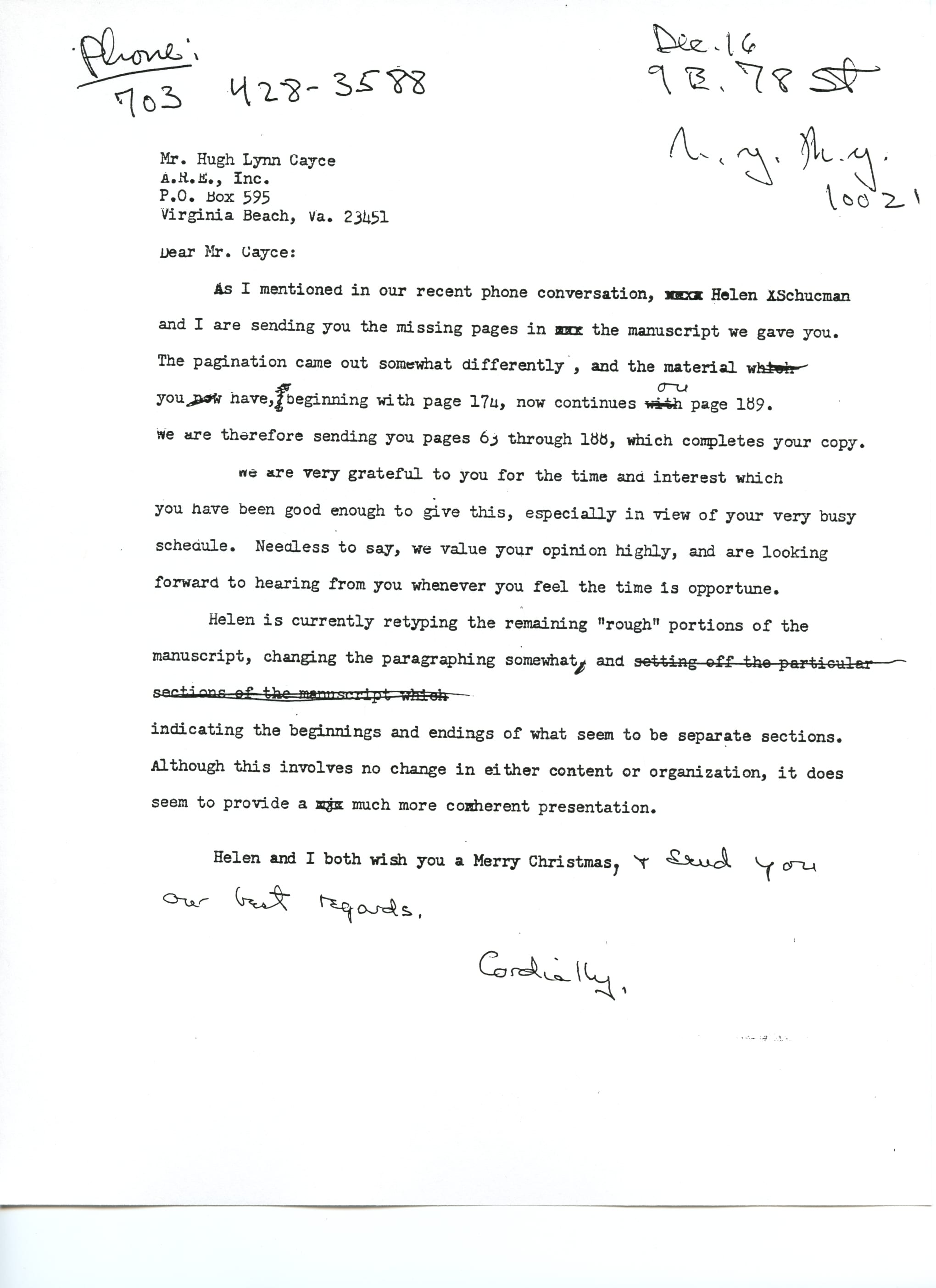
December 1970 letter from Bill to Hugh Lynn noting Helen as “retyping the remaining ‘rough’ portions of the manuscript, changing the paragraphing somewhat, and indicating the beginnings and endings of what seem to be separate sections.” Whether this refers to Helen’s typing of the second draft or the HLC is unclear. It does, though, confirm her role in retyping the manuscript.
Examination of examples of editing
Here we look closely at the editing that occurred from the Notes to the HLC and then to the FIP. These are quite revealing about the HLC, as well as about the editing patterns that occur across all the versions.
In miracle principle 4/5, all of the editing takes place by the HLC, before the FIP
We see this early miracle principle dramatically change over five versions: the Notes, two versions in the Urtext, the HLC, and the FIP. By the time of the HLC, two of the three sentences are completely changed, and 29 words have been changed, added, or removed. There are no changes between the HLC and the FIP. This is an extreme example, but it shows what can be seen throughout: most of the editing has already happened by the HLC.

We see similar patterns in a sample passage from Chapter 1
Here, we look at just three versions: the Notes, the HLC, and the FIP. Spend time comparing the three versions. Here is the key to the highlighting:
- Yellow: sentences that have the same wording as the previous version
- Light gray: sentences that contain wording changes from the previous version
- Dark gray in the Notes: words that are removed in the HLC
- Dark gray in the HLC and FIP: words that have been changed from the previous version


What we see here is that most of the change happens by the HLC, not in the FIP:

In all four measures, the HLC accounts for most of the change. There are changes that happen in the FIP, but they are fewer.
It should be noted that this passage in the FIP has been relocated and scattered across three sections. That relocation is a significant change in itself. Some passages in the HLC were relocated—about 1,000 words by our count. However, there is a great deal more in the FIP—about 5,000 additional words by our count. It’s worth nothing, though, that Ken Wapnick claimed that the relocating of material in the FIP was done with Bill’s approval: “Any changes we made in the order of material….we showed Bill” (Absence from Felicity, p. 363).
To learn more about our community of A Course in Miracles students, visit Course Companions.


